
How Databricks Engineers Disqualify Themselves From Promotion in 30 Seconds
What managers actually hear when you read your Jira board (3 minutes)

A Databricks engineering manager running a 12-person team told me recently that he’d already decided who was getting promoted this quarter. The review cycle hadn’t even opened yet.
His method wasn’t performance reviews, code quality scores, or ticket throughput. It was standup. Specifically, the first 30 seconds of how each engineer described what they were working on.
What Most Engineers Get Wrong About Standup
Most Databricks engineers treat standup as a status report. They open Jira, read the ticket IDs they touched yesterday, name the ones they’ll touch today, and confirm “no blockers.”
The internal logic feels correct: the manager wants to know I’m working. I’m telling them I’m working. Done.
But that’s not what’s happening on the receiving end. The manager isn’t auditing your hours. They’re running a daily, low-stakes simulation of what it would be like to put you in a senior role. Every standup is a 60-second behavioral interview, and ticket-reading is the answer that fails it.
The signal isn’t the work itself. It’s how you frame the work.
What Managers Actually Hear
I’ve spoken with several Databricks engineering managers across retail, fintech, and healthcare data teams. Every one of them described the same mental sort happening in real time during standup. The engineers who report tasks get filed mentally as “task executors.” The engineers who report outcomes get filed as “operators.” Only the second category gets seriously considered for the next level.
Here’s the breakdown of what each style signals:
“Yesterday I worked on DATA-3421. Today I’m continuing DATA-3421. No blockers.”
Manager hears: “Give me the next ticket. I will not surface decisions you need to make. I will not connect my work to anything that matters to the business.”
Career signal: Mid-level ceiling. Comfortable salary band of $135K-$165K. Promotable to senior in 3-5 years if technical chops grow, but not on this manager’s shortlist.
“Cut finance dashboard latency from 45 minutes to 8 minutes yesterday. Sarah in FP&A needs the rerun for Friday’s board deck. Today I’m validating row counts against the legacy report. Blocked on Unity Catalog grants from the platform team. Pinged Raj, ETA tomorrow.”
Manager hears: “I own outcomes. I know who’s waiting on me. I move my own blockers. You can put me in front of a stakeholder without preparation.”
Career signal: Senior-track. $200K+ band. On the shortlist before the review cycle opens.
Same engineer could deliver either version. Same work, same hours, same code merged. The difference is entirely in framing, and managers are sorting on framing whether they realize it or not.
Why Managers Decide Promotions Months Before the Review
Promotion calibration meetings have a structure most engineers never see. Managers walk in with a shortlist already drafted. The meeting is for defending the list, not discovering it.
That shortlist gets built across roughly 60 standups per quarter. By the time the formal review window opens, the manager has heard you describe your work over 200 times across a year. Patterns are baked in. The engineer who consistently sounds like an owner has been mentally promoted for months. The engineer who consistently sounds like a task-taker has been mentally filed as “still developing.”
This is why “I’ll prove myself during review season” doesn’t work. Review season is when the manager defends decisions, not makes them. The decision was made in standup, in Slack threads, and in stakeholder meetings. That’s the daily surface area where you either sound senior or you don’t.
The promotion delta between mid-level and senior at most Databricks shops is roughly $40K-$60K in total comp. That gap is being decided in 60 seconds a day, every weekday, by a habit most engineers haven’t audited since their first job.
The 60-Second Senior Standup Template
Here’s the exact framework. Four parts. Each line replaces a junior reflex with a senior signal.
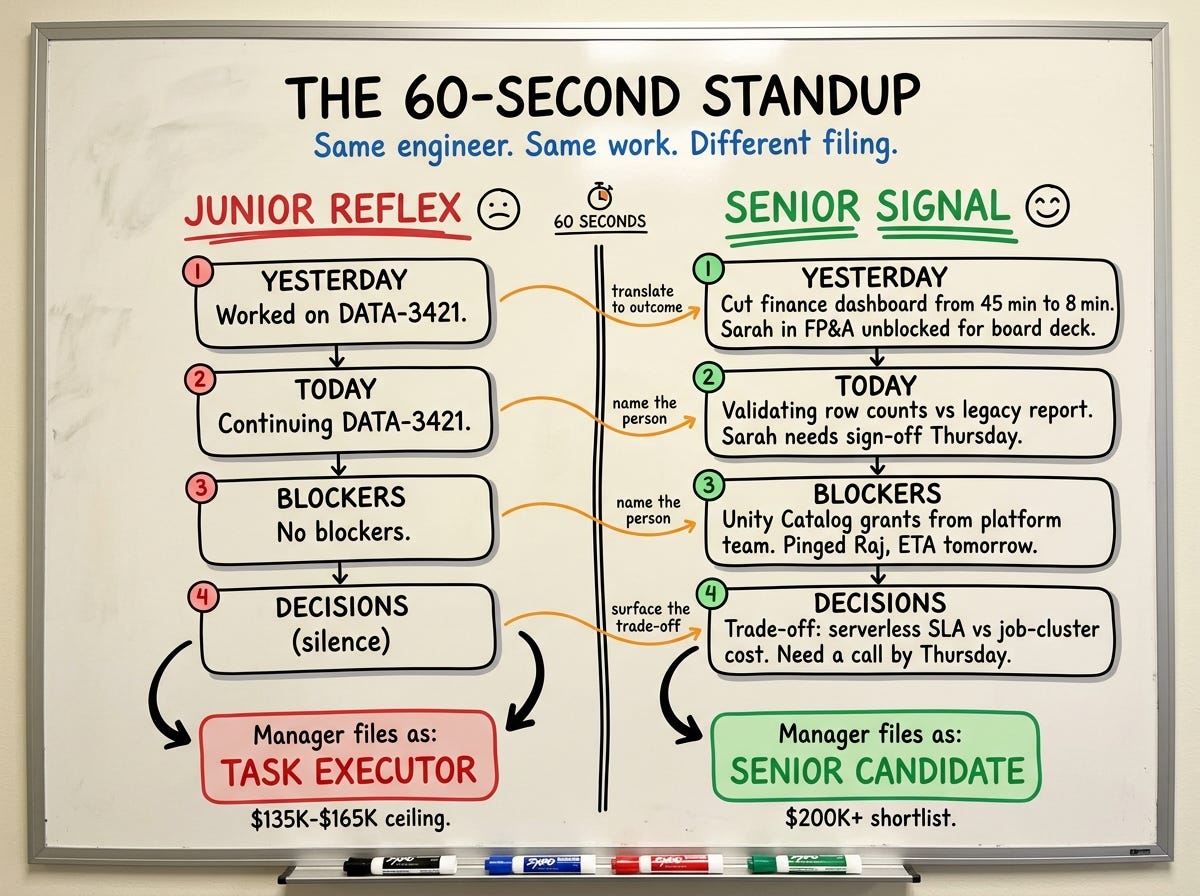
Part 1: Yesterday. Outcome delivered + who benefits.
Junior reflex: “Worked on DATA-3421.”
Senior version: “Cut the finance dashboard refresh from 45 minutes to 8 minutes. Sarah in FP&A is unblocked for the board deck.”
The frame: lead with the business outcome. The ticket ID is invisible noise; the latency cut and the named stakeholder are the signal.
Part 2: Today. Outcome in flight + named stakeholder.
Junior reflex: “Continuing DATA-3421.”
Senior version: “Validating row counts on the new pipeline against the legacy report. Sarah needs sign-off by Thursday so she can pull the final numbers Friday morning.”
The frame: name the deliverable in business terms and tie it to a person with a deadline. This signals you understand WHO consumes your work, not just WHAT you ship.
Part 3: Blockers. Specific person + ETA.
Junior reflex: “No blockers.” (Or worse: “Blocked on platform team.”)
Senior version: “Blocked on Unity Catalog grants from the platform team. Pinged Raj directly, he committed to having it done tomorrow.”
The frame: blockers with named owners and ETAs prove you’re moving them yourself. “No blockers” when you actually have blockers reads as either dishonest or oblivious. Both are senior-disqualifiers.
Part 4: Decisions the manager needs to make
Junior reflex: silence. Decisions get hoarded until you’ve “figured it out.”
Senior version: “Trade-off coming up: we can hit the SLA on serverless compute or cut compute cost meaningfully with a job cluster that adds a few minutes of latency to each run. Need a call by Thursday so I can finalize the deployment.”
The frame: a senior surfaces decisions framed for the manager, not solved by the engineer. This is the single most important habit. It signals you understand the difference between technical decisions (yours) and business trade-offs (theirs). Most promotions hinge on this one shift.
