
7 Reasons Databricks Data Engineer Offers Disappear Before You Get Them
None of them are about your Spark skills (5 min read)

A hiring manager told me his team rejected 3 candidates who aced every question last quarter. None failed technically. That conversation changed how I think about job offers.
Most engineers replay interviews for weeks after a rejection, running through every answer like game tape. But the people making decisions aren’t always evaluating your answers. They’re navigating budget cycles, headcount politics, and committee dynamics that have nothing to do with you.
The Mental Model That’s Costing You Months
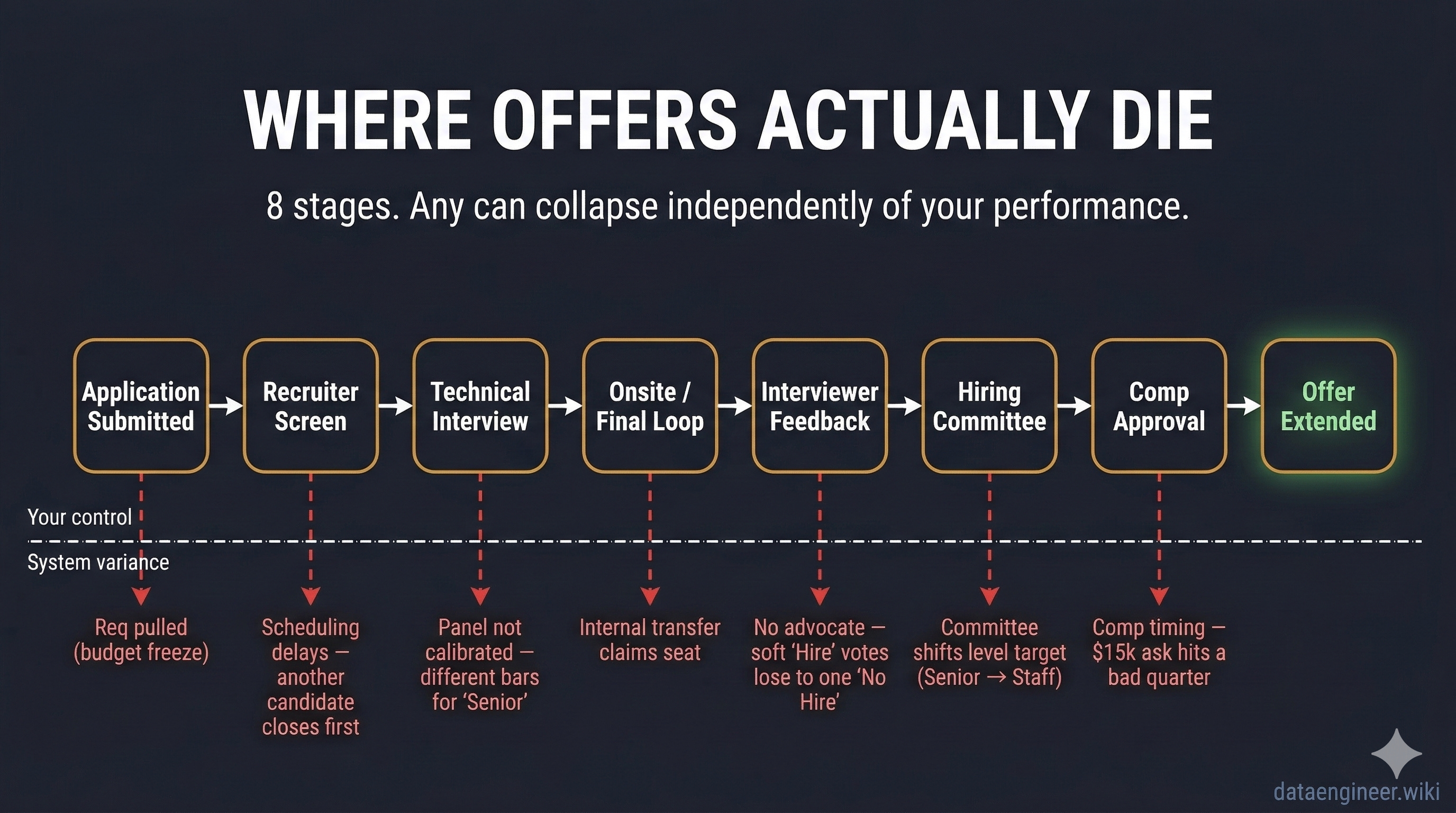
Most engineers operate with: study hard, ace interviews, get offer. Simple meritocracy.
The actual process has 8+ steps, and any of them can collapse independently of candidate quality. Your performance in the interview doesn’t protect you from a budget freeze, an internal transfer, or a comp band ceiling decided in a meeting you’ll never know about.
7 Reasons Offers Disappear (That Aren’t Your Skills)
1. Headcount got frozen mid-loop
Budget approvals run quarterly. You interviewed in week 8. Finance pulled the req in week 11. You get a polite rejection and assume you failed. The role stopped existing. The tell: 2+ weeks of silence after your final interview, then a generic rejection with no specific feedback. During market corrections, 10-15% of open data engineering roles get pulled before an offer goes out.
2. An internal transfer claimed the seat
You’re competing against internal candidates you’ll never know about. They cost zero recruiter fees (vs. $30k-$50k for external hires at the $200k comp level), they’re a known quantity with performance reviews, and approving their transfer solves a retention problem. A hallway conversation between two managers can close your pipeline overnight.
3. The hiring committee wanted a different level.
You interviewed for Senior. The committee realized they need Staff. Your answers were right -- the target moved. Common in Databricks roles because “Senior Data Engineer” spans everything from pipeline builder to lakehouse architect.
4. Your interviewers disagreed and nobody fought for you.
A single “No Hire” with conviction outweighs two soft “Hire” votes. A “pretty good” performance across all rounds is riskier than crushing three and being mediocre in one -- “pretty good” gives nobody ammunition to advocate.
5. Timing killed the comp negotiation.
They wanted to offer $195k. You asked for $210k. The hiring manager just lost a budget fight for $50k in tooling. Your $15k delta became politically impossible that quarter. Three months later, same company, same role -- the answer would have been yes.
6. The recruiter dropped the ball.
Recruiters managing 15-30 open reqs. Your scheduling slipped three weeks. Another candidate completed their loop first. You’re interviewing for a role that’s already been verbally committed.
7. The interview panel wasn’t calibrated.
Interviewer A thinks Senior means designing real-time fraud detection end-to-end. Interviewer B thinks it means optimizing batch pipelines. You prepared for B’s bar. A interviewed you.
The Tactical Playbook
Run 3-5 parallel interview processes.
If each interview process has a 20-25% chance of producing an offer, running 5 gives you a 67-76% chance of at least one. 80% of Databricks interview prep is transferable across companies - the marginal cost of interview process #4 is far lower than of #1.
Time your applications strategically.
Best months: January-February (new annual budgets) and September-October (Q4 rush to fill headcount). Worst: November-December. Submit all applications within a 2-week window so processes run in parallel and you get overlapping offers.
Build advocates before the committee.
Connect with team members before applying. Give memorable, specific answers (”We had a 500GB Delta table scanning full partitions on every query -- here’s what I did” beats “I would use liquid clustering”). The interviewer needs to remember you specifically when writing feedback.
Diagnose rejection type before changing anything.
Long silence + generic rejection + role reposted later = process failure, not your skills. Quick rejection with specific technical feedback = real gap to address. The critical mistake: treating every rejection as a performance gap and changing your prep after each one.
Negotiate like you know the constraints.
Ask the recruiter for the approved comp band directly. Time above-band asks to the start of a quarter. Frame asks around value (”I’ve managed a 50-node deployment processing 3TB daily”) not market data (”Glassdoor says $210k”). If base is stuck, ask about sign-on bonus or equity -- these often come from different budget lines.
The Pattern
The engineers landing $200k+ roles aren’t better at Spark. They’re better at playing a volume game against a system with high variance and low transparency.
Control the inputs. Accept the variance on the outputs. Run enough attempts that the variance works in your favor.
Have you ever gotten a rejection that felt wrong? Looking back, was it the system, not your skills?